
Product Care
[vc_row][vc_column][vc_custom_heading text=”CARING FOR YOUR TWISTED WOOD UKULELE” font_container=”tag:h2|text_align:center” google_fonts=”font_family:Lato%3A100%2C100italic%2C300%2C300italic%2Cregular%2Citalic%2C700%2C700italic%2C900%2C900italic|font_style:900%20bold%20regular%3A900%3Anormal”][vc_column_text]

CLEANING
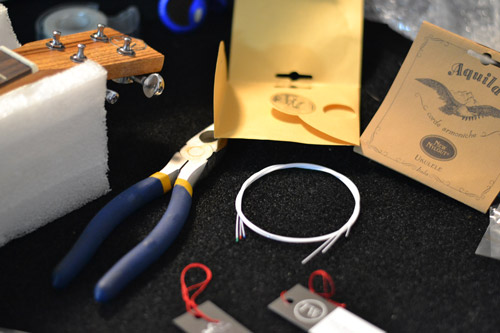
When cleaning, use a damp lint-free cloth then buff with a clean dry cloth. The fretboard and bridge will periodically need treating with mineral oil to avoid the exposed wood from drying out. It is a good idea to lubricate the tuning machine heads once a year with a heavy lubricant, such as Vaseline, to help keep them moving freely
STORAGE, TEMPERATURE, AND HUMIDITY
To avoid shrinkage, cracking, swelling, and warping of your ukulele, you must keep it in an environment which provides fairly constant temperature and humidity year round. The optimum humidity level is between 45% and 55% and the optimal temperature is between 65 & 80 degrees. Sudden changes or exposure to extreme temperatures or humidity can cause damage to the wood and glue. It is always best to keep your ukulele in its hard case or gig bag when not in use
RESTRING MY UKULELE
How often you restring your ukulele is up to you really. It depends on how much you play your ukulele and how hard. Some people change them after a few weeks, other people after months. We recommend changing your Aquila strings every 4-6 months. When replacing strings, do not just replace one string, but replace all of the strings because the others are probably worn out also. A few signs indicating restringing is needed:
– You find yourself tuning your ukulele a lot more than usual.
– The string doesn’t feel as smooth as it used to feel. There might be some grooves in it due to pressing strings over the frets.
– The sound isn’t as clear, bright, and loud as it should be.
ELECTRONICS
If your pickup system uses batteries, be sure to unplug it during breaks. Keep spare batteries in your case for when you need them most. Also, when restringing, replace one string at a time to maintain even pressure across the bridge saddle. If you would like to install a pickup into your uke, TW proudly offers 3 different pickup systems which you can purchase through any one of our dealers. Of course, be sure to have all pickup systems installed by a qualified instrument repair technician.[/vc_column_text][vc_custom_heading text=”CARING FOR YOUR TWISTED WOOD GUITAR” font_container=”tag:h2|text_align:center|color:%23333333″ google_fonts=”font_family:Lato%3A100%2C100italic%2C300%2C300italic%2Cregular%2Citalic%2C700%2C700italic%2C900%2C900italic|font_style:900%20bold%20regular%3A900%3Anormal”][vc_column_text]
TUNING
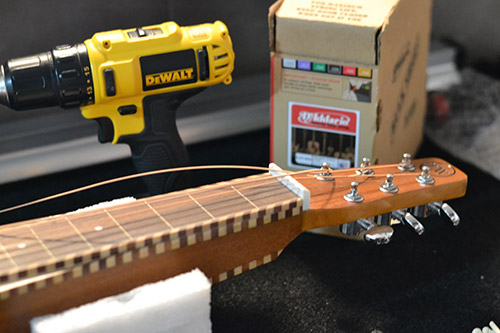
Before dispatch, your guitar will be securely packed to help ensure a safe delivery. We will have already set up your guitar to achieve optimal playability. The first thing you will need to do is to tune your new guitar. Great care must be taken when choosing your tuning. Too high of a tuning, or too large gauge of strings can cause damage to the guitar. Recommended tunings are (G) DGDGBD, (D) DADF#AD and (C) CGCEGC. There is a wide range of different tunings that you can experiment with as you grow in confidence. A balance must be achieved between string gauge and the keynote, to ensure the string tension is never too high.
Your instrument has been strung with D’Addario EJ-17 (13-56) med. phosphor bronze strings.
CLEANING
When cleaning, use a damp lint-free cloth then buff with a clean dry cloth. The fretboard and bridge will periodically need treating with mineral oil to avoid the exposed wood from drying out. It is a good idea to lubricate the tuning machine heads once a year with a heavy lubricant, such as Vaseline, to help keep them moving freely.
STORAGE, TEMPERATURE, AND HUMIDITY
To avoid shrinkage, cracking, swelling, and warping of your guitar, you must keep it in an environment which provides fairly constant temperature and humidity year round. The optimum humidity level is between 45% and 55% and the optimal temperature is between 65 & 80 degrees. Sudden changes or exposure to extreme temperatures or humidity can cause damage to the wood and glue. It is always best to keep your guitar in its hard case or gig bag when not in use[/vc_column_text][/vc_column][/vc_row]